
Updated 16 November 2026 · Albert & Yin Estate editorial team
Budget the actual building maintenance charge plus the separate sinking-fund contribution. Then allow for costs inside your own parcel and any approved special contributions. A quoted rate per square foot is a starting estimate, not a full ownership budget.
An illustrative apartment budget
Assume a 1,000 sq ft unit, an estimated RM0.35 per sq ft maintenance charge and a sinking-fund contribution equal to 10% of that charge.
| Item | Monthly | Annual |
|---|---|---|
| Maintenance | RM350 | RM4,200 |
| Sinking fund at 10% | RM35 | RM420 |
| Combined | RM385 | RM4,620 |
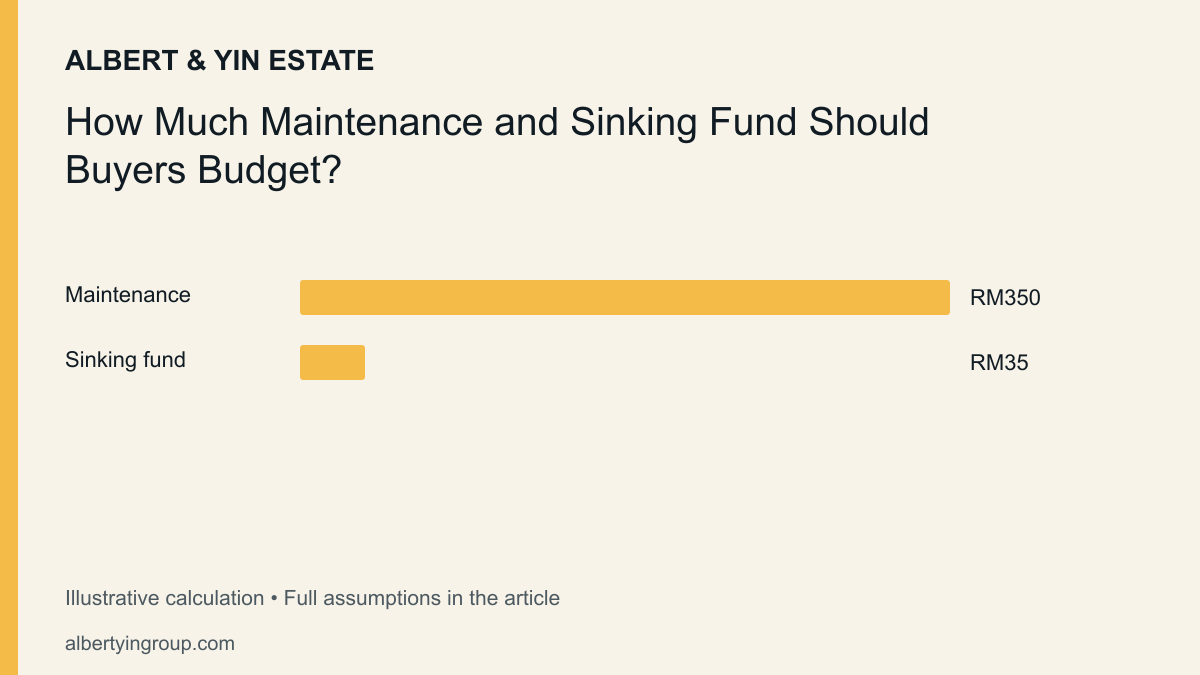
The rate is an example, not a market average. Actual allocation can depend on share units and the applicable management-stage rules. Obtain the current invoice and adopted budget for the unit.
What is the sinking fund for?
It provides a separate reserve for qualifying capital expenditure, rather than everyday operations. Under the Management Corporation provisions of the Strata Management Act, contributions are generally at least 10% of charges, subject to the applicable determination at a general meeting. Strata Management Act 2013, section 61.
Why a cheap monthly rate can mislead
Compare the annual budget, collection rate, arrears and major repair programme. A building may need work on lifts, waterproofing, pumps or the facade. If reserves do not cover the approved programme, owners can face additional contributions or future increases.
Request these before buying a subsale
- Latest parcel statement and confirmation of arrears.
- Recent audited accounts and AGM minutes.
- Sinking-fund balance and planned capital works.
- Current insurance details and maintenance contracts.
- Approved special contributions and who pays them under the SPA.
Keep a parcel reserve too
The building’s sinking fund is not your personal appliance-replacement account. Add an allowance for air-conditioning, plumbing inside the unit, furnishing, insurance where relevant and periods without rent. Use an equipment list and replacement estimates rather than a universal percentage.
A five-year reserve exercise
Assume the example’s combined monthly charge remains RM385 for the first year. The annual bill is RM4,620. If the combined charge rises by an illustrative 5% each year, the annual bills become RM4,851, RM5,093.55, RM5,348.23 and RM5,615.64 in years two to five. Total payments over the five years are approximately RM25,528.42.
That rate increase is a modelling assumption. Replace it with the approved budget and any announced change. Add special contributions separately, with their due dates, so the model shows the cash needed even when a payment is spread over instalments.
Questions buyers commonly ask
Are charges calculated only from the advertised floor area?
Ask management for the parcel’s share units and the calculation used on the invoice. For an estimate based on floor area, record whether car parks or other entitlements affect the charge. Reconcile the estimate with the actual adopted billing basis.
Will the sinking fund pay for repairs inside my apartment?
Ask management which works fall under the common-property budget and identify the repairs allocated to the parcel owner. Keep a personal reserve for equipment and works you must fund. Check the building insurance and your own cover when assessing an insured event.
Who pays charges during a vacant period?
Include the owner’s applicable charges in every month of the investment model, including periods without a tenant. Use the tenancy to establish which expenses can be recovered from the occupier and keep the management account current.
At handover, record meter deposits, access-device charges and opening management payments separately from the recurring monthly rate. For resale, ask the solicitor to reconcile the account and completion adjustments. Keep the final statement with the ownership documents.
For a new launch, label charges as estimates until adopted. For a completed building, use current documents. The best budget is a schedule of known bills, planned replacements and a cash reserve tied to the particular property.
Related: Compare property listings · About Albert & Yin.